Save the answer (SQL, question, documentation, context) with links to dashboards/apps, so your team can get consistent answers fast and prevent unnecessary rework.
What are the top 10 products by revenue in the last 30 days?
This answer identifies your best-selling products by revenue contribution over the last 30 days.
"Revenue" is defined as the sum of product_price from
the order_items table.
"Last 30 days" is interpreted as the 30-day period immediately
preceding the current timestamp when the query is executed... View More
| product_id | product_name | total_revenue | revenue_rank |
|---|---|---|---|
|
|
|
|
|
| BEV-004 | for richer or pour | $8,3447 | 1 |
| JAF-004 | flame impala | $7,2436 | 2 |
| BEV-003 | vanilla ice | $7,1856 | 3 |
| BEV-001 | tangaroo | $7,1484 | 4 |
| JAF-005 | mel-bun | $6,1128 | 5 |
| JAF-003 | the krautback | $6,0936 | 6 |
| BEV-002 | chai and mighty | $5,9855 | 7 |
| JAF-001 | nutellaphone | $5,5451 | 8 |
| JAF-002 | doctor stew | $5,5154 | 9 |
| BEV-005 | adele-ade | $4,7088 | 10 |
Not just a number or a chart, all the context your team needs to reuse it confidently.
Automatically Captured in plain English so it's easy to search.
The exact code used, including templates and parameters.
Deep links to related Sigma dashboards and Retool apps.
Related key terms (e.g., “activation date”, “ARR”).
Notes on how to use it (“don’t use this for revenue reporting”).
Descriptions, ownership info, last updated dates, and tags for discovery.
Capture what worked once and reuse it everywhere.
Ask a question (business user) and save the answer or write a query (technical user).
runQL automatically enriches the query with descriptions, links, and documentation.
Edit anything and then publish the answer to the Library (optionally review/approve).
Now when a team member searches or asks a question, the answer is suggested instantly.
Your team can instantly find and reuse the answers they need.
When you get an instant answer to your question or write a query (technical person), you can instantly save that answer for reuse by your team. The question, description, notes, SQL, chart code, and related resources are automatically created and saved together.
This answer identifies your best-selling products by revenue contribution over the last 30 days.
"Revenue" is defined as the sum of product_price from
the order_items table.
"Last 30 days" is interpreted as the 30-day period immediately
preceding the current timestamp when the query is executed... View More
Custom Note
When a new dataset comes online, runQL can automatically create questions and answers so the most likely questions are already answered, reviewed, and ready before anyone asks. The seed answers are created from your schema + automatic semantic definitions, and you can also import your existing ticket backlog to kick of a seed answer process.
Based on schema structure and definitions.
SQL + documentation created automatically.
Expert verifies and makes them reusable.
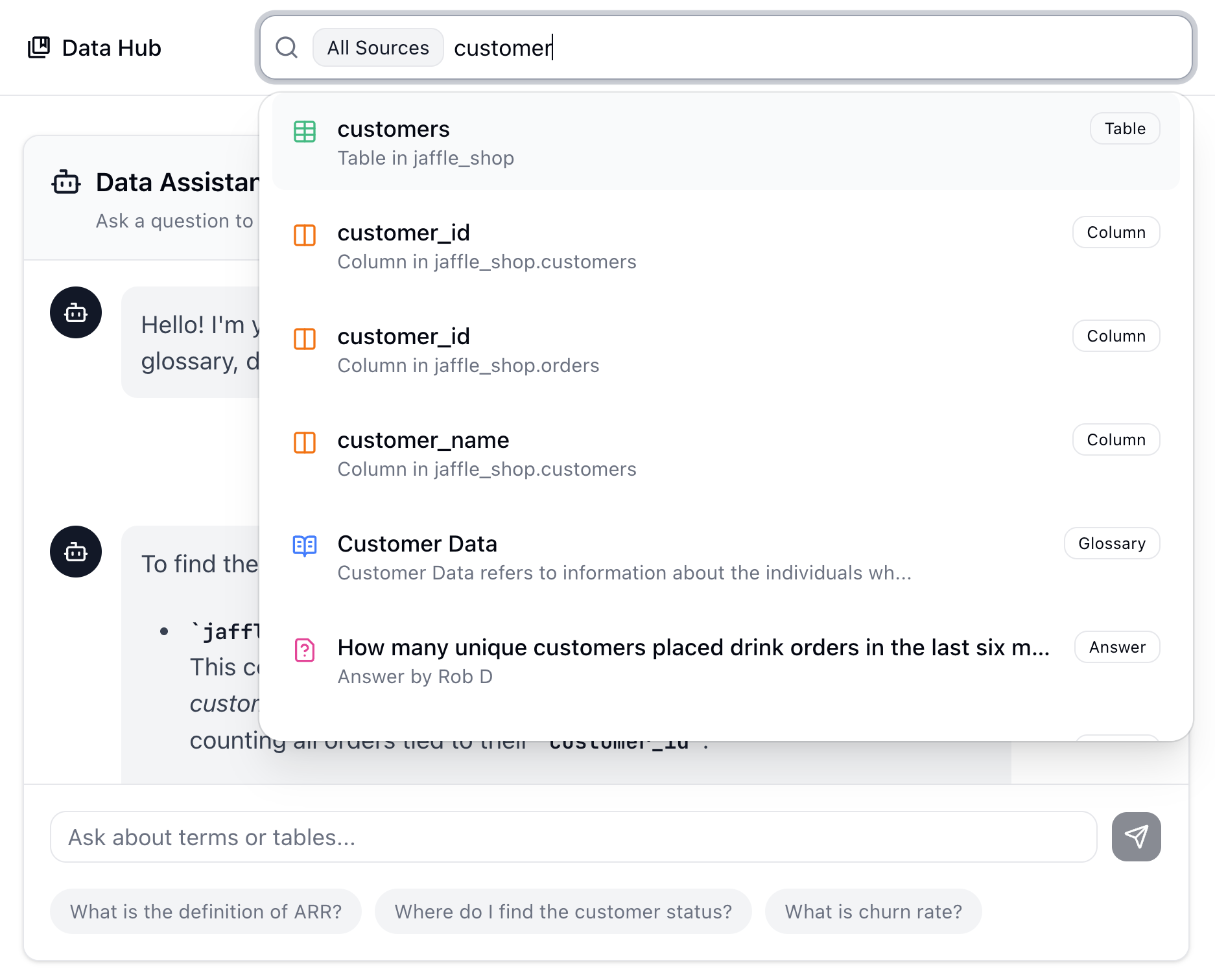
Your team can find answers by business question or keyword. No need to know the exact column name, just ask like a human.
When someone on your team asks or searches, they will be presented instantly with a saved answer, if there is one.
This answer identifies your best-selling products by revenue contribution over the last 30 days.
"Revenue" is defined as the sum of product_price from
the order_items
table.
"Last 30 days" is interpreted as the 30-day period
immediately
preceding the current timestamp when the query is
executed... View more
| product_id | product_name | total_revenue | revenue_rank |
|---|---|---|---|
| BEV-004 | for richer or pour | $8,3447 | 1 |
| JAF-004 | flame impala | $7,2436 | 2 |
You’re not stuck with the automated text. Your team owns the final definitions.
Edit any documentation, tags, or metadata to match your business.
Your manual edits automatically became the source of truth over AI versions.
Let your team quickly select specific values (e.g. Region, Segment).
Warn users about specific caveats (e.g., “don’t use this for revenue reporting”).
The same questions come up weekly.
People rebuild dashboards because they can’t find prior work.
You want one place for “how we answer this”.
You want faster onboarding (“here’s how we measure X”).
You want logic, documentation, and links captured together.
Most teams aren’t short on data, they’re short on reusable answers.